- Published on
CWL - Whispers from SQS
- Authors

- Name
- mfkrypt
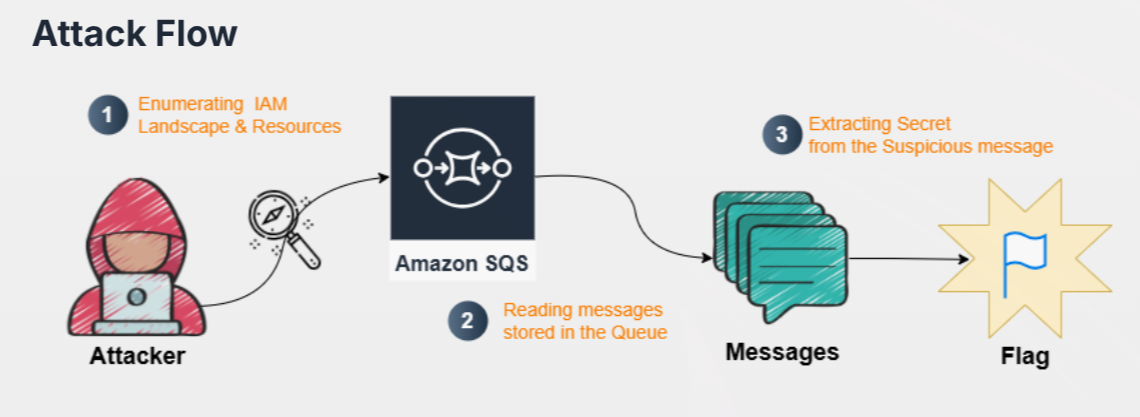
Table of Contents
Recon
We are given the following credentials:
Proceed to authenticate. Just provide any random region and we can leave out the output format field
aws configure
Verify the authentication by making an API call
aws sts get-caller-identity
Our current user is queue-inspector
IAM Enumeration
Policies
Let's try to find policies
aws iam list-user-policies --user-name queue-inspector
{
    "PolicyNames": [
        "queue-inspector-user-policy"
    ]
}
Retrive the contents of the policy
aws iam get-user-policy --user-name queue-inspector --policy-name queue-inspector-user-policy
{
    "UserName": "queue-inspector",
    "PolicyName": "queue-inspector-user-policy",
    "PolicyDocument": {
        "Version": "2012-10-17",
        "Statement": [
            {
                "Sid": "Statement1",
                "Effect": "Allow",
                "Action": [
                    "sqs:ListQueues"
                ],
                "Resource": "*"
            },
            {
                "Sid": "Statement2",
                "Effect": "Allow",
                "Action": [
                    "sqs:GetQueueUrl",
                    "sqs:GetQueueAttributes",
                    "sqs:ReceiveMessage"
                ],
                "Resource": "arn:aws:sqs:us-east-1:058264439561:secops-messanger-queue"
            },
            {
                "Sid": "Statement3",
                "Effect": "Allow",
                "Action": [
                    "iam:ListUserPolicies",
                    "iam:GetUserPolicy"
                ],
                "Resource": "arn:aws:iam::058264439561:user/queue-inspector"
            }
        ]
    }
}
We see a few permissions related to SQS. Amazon Simple Queue Service (SQS) is a service that allows point-to-point communication, ensuring that messages are processed by a single consumer. It offers at-least-once delivery, supports standard and FIFO queues, and allows message retention for retries and delayed processing.
SQS Enumeration
Based, on the permissions we can get the list of queues and the queue attributes. Apart from that, we notice that the user has the sqs:ReceiveMessage permission. We can attempt to use this to receive the messages from the current queue
aws sqs list-queues
{
    "QueueUrls": [
        "https://sqs.us-east-1.amazonaws.com/058264439561/secops-messanger-queue"
    ]
}
Let's get the queue attributes of this url queue
aws sqs get-queue-attributes --queue-url https://sqs.us-east-1.amazonaws.com/058264439561/secops-messanger-queue --attribute-names All --region us-east-1
{
    "Attributes": {
        "QueueArn": "arn:aws:sqs:us-east-1:058264439561:secops-messanger-queue",
        "ApproximateNumberOfMessages": "14",
        "ApproximateNumberOfMessagesNotVisible": "0",
        "ApproximateNumberOfMessagesDelayed": "0",
        "CreatedTimestamp": "1752125969",
        "LastModifiedTimestamp": "1752131927",
        "VisibilityTimeout": "30",
        "MaximumMessageSize": "262144",
        "MessageRetentionPeriod": "1209600",
        "DelaySeconds": "0",
        "Policy": "{\"Version\":\"2012-10-17\",\"Id\":\"__default_policy_ID\",\"Statement\":[{\"Sid\":\"__owner_statement\",\"Effect\":\"Allow\",\"Principal\":{\"AWS\":\"arn:aws:iam::058264439561:root\"},\"Action\":\"SQS:*\",\"Resource\":\"arn:aws:sqs:us-east-1:058264439561:secops-messanger-queue\"}]}",
        "ReceiveMessageWaitTimeSeconds": "0",
        "SqsManagedSseEnabled": "false"
    }
}
Observe the ApproximateNumberOfMessages has the value of 14. We'll try to read these messages and fid the flag. However, SQS works with short polling by default, which only queries a subset of servers and often returns fewer messages than requested when queue volumes are low. Meaning the same message won't return everytime (I still have yet to understand this mechanism). So, if we spam this command below:
aws sqs receive-message --queue-url https://sqs.us-east-1.amazonaws.com/058264439561/secops-messanger-queue --region us-east-1 --max-number-of-messages 10
We would be more likely see all of the messages just not at the same time. Like the message below, we can observe a string which appears to be encoded in Base64
❯ echo 'Q1dMe1dlc3NnYWVfUmV0cmlldmViX1N1KSllc3NmdWxseX0=' | base64 -d

CWL{Wessgae_Retrieveb_Su))essfully}
And there's our flag